The next stage of AI: from answers to action
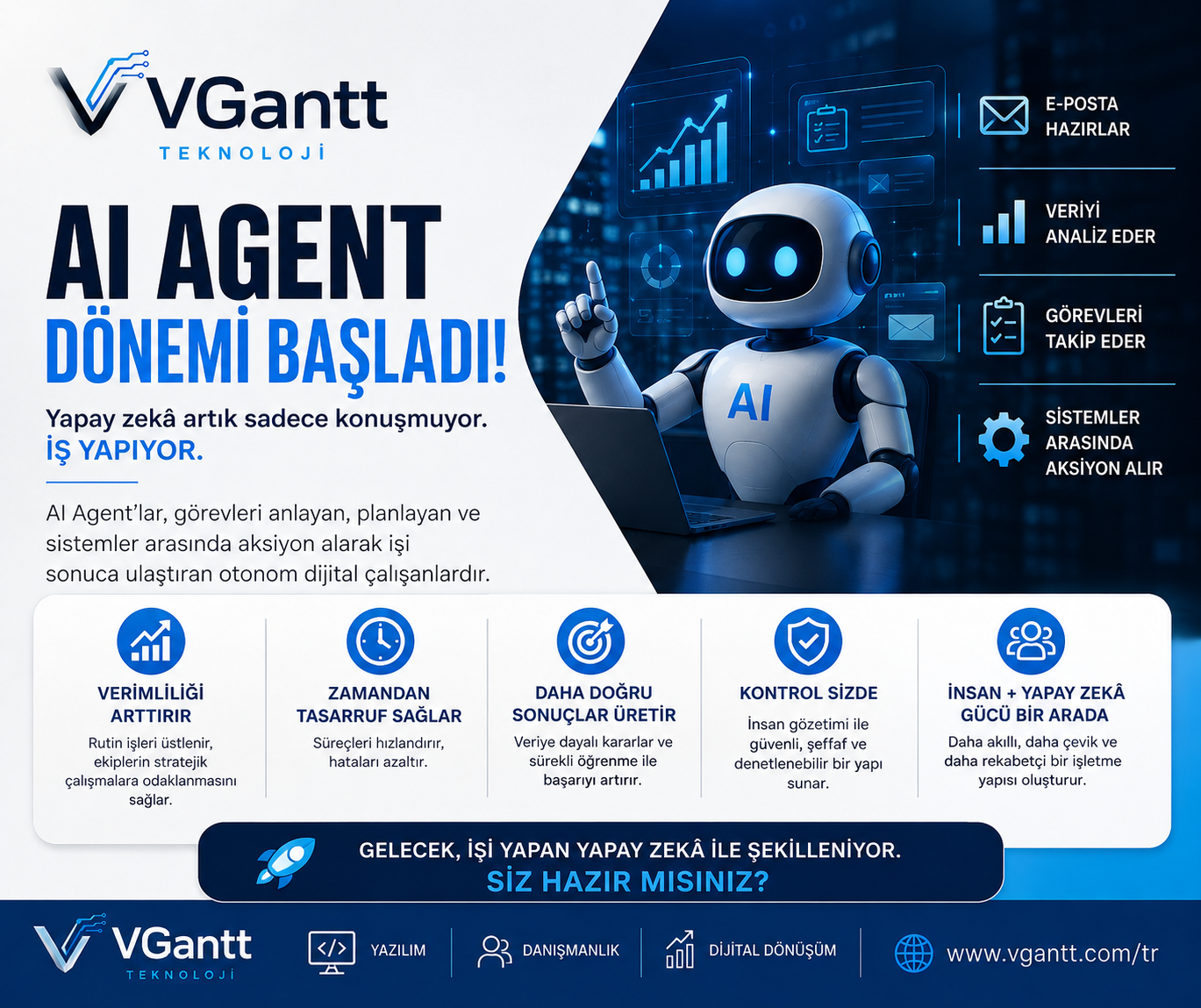
Generative AI has mainly been used to answer questions, create content, and retrieve information. AI agents take the next step: they can interpret a goal, plan the work required, use approved tools, and take controlled action across business systems.
An AI agent is best understood as a governed participant in a digital workflow. Its value is not measured only by the quality of its language, but by whether it can complete the right task with trusted data, appropriate permissions, and measurable outcomes.
What is an AI agent?
An AI agent is a system that can understand an objective and execute a sequence of tasks to achieve it. In an enterprise setting, it may connect to email, CRM, ERP, calendars, service desks, databases, document platforms, or custom software through controlled APIs.
- It interprets the objective and its success criteria.
- It breaks a larger job into manageable steps.
- It selects from authorized tools and information sources.
- It performs actions such as creating records, preparing reports, or opening tasks.
- It checks results and adjusts the plan when required.
- It requests human approval for sensitive or irreversible actions.
How is an AI agent different from a chatbot?
A chatbot typically produces a response. An agent works toward an outcome. A chatbot can explain how to find delayed orders; an authorized agent can retrieve those orders from ERP, prioritize them, identify owners, prepare a management summary, and request approval before sending it.
This capability also creates responsibility. Organizations must define which tools an agent can use, what data it can see, which actions it may perform independently, and when a person must remain in the loop.
How does an AI agent work?
- Objective: Define the expected task and success criteria.
- Context: Evaluate user role, company policies, trusted records, and current data.
- Planning: Break the task into an ordered workflow.
- Tool calling: Use only approved systems and functions.
- Validation: Check intermediate results against rules and confidence thresholds.
- Approval or action: Complete low-risk work and route critical operations to a person.
- Audit and feedback: Record the action and measure its business outcome.
Enterprise AI agent use cases
- Email and communication: classify requests, draft responses, route work, and create follow-up tasks
- Sales: enrich CRM records, summarize meetings, research prospects, and coordinate proposal preparation
- Customer service: retrieve grounded answers, open tickets, determine priority, and monitor resolution
- Finance: review documents, flag reconciliation differences, and prepare exception summaries
- Procurement: compare quotations, identify missing documents, and initiate approval workflows
- Manufacturing and maintenance: interpret fault records, draft work orders, and escalate critical events
- People operations: support onboarding checklists, internal knowledge access, and learning follow-up
- Business Intelligence: combine data, detect anomalies, prepare executive summaries, and recommend action
The operating model is Human + AI
The future is not about handing every decision to AI. People define strategy, policy, ethics, and success measures. Agents support repetitive research, preparation, control, and follow-up. High-impact decisions and exceptions remain under human judgment.
Human oversight becomes stronger when every tool call is visible, the basis of an action can be explained, and an authorized person can stop or reverse the workflow.
Essential controls for safe AI agents
- Least privilege: provide only the data and functions required for the role.
- Human approval: require authorization for payments, contracts, deletions, bulk messages, and commitments.
- Audit trail: record source data, tool calls, outcomes, and approvals.
- Data protection: apply privacy, retention, masking, and confidential-data policies.
- Safe failure: stop and escalate when information is uncertain or a system responds unexpectedly.
- Operational limits: define time, cost, value, volume, and repetition thresholds.
- Continuous testing: evaluate real scenarios, malicious inputs, and unexpected dependencies.
A practical adoption roadmap
- Select a repetitive process with clear rules, sufficient volume, and measurable impact.
- Measure the current cycle time, error rate, cost, and user experience.
- Document what the agent may and may not do.
- Begin integrations with least-privilege access.
- Add human approval, observable logs, and rollback for critical actions.
- Pilot with a limited user group and measure business outcomes as well as accuracy.
- Expand only after value and safe behavior have been demonstrated.
Measure business value, not just response quality
Track task completion, cycle time, human intervention, error and rollback rates, operating cost, adoption, satisfaction, and the resulting business KPI. An agent that performs more actions but creates greater review overhead has not delivered real efficiency.
Is your organization ready for the AI agent era?
AI agents are turning artificial intelligence from a passive information tool into an active part of enterprise workflows. Sustainable value requires the right use case, trusted data, controlled integration, clear authority boundaries, and human oversight.
VGantt combines ERP, Business Intelligence, custom software, data integration, and AI capabilities to help organizations design secure and measurable agent solutions. The question is no longer only whether to use an AI agent, but which process to transform, under which controls, and toward which business outcome.