AI is no longer a future topic—it is a management decision today
Artificial intelligence is reshaping how businesses operate, make decisions, and serve customers. Competitive advantage no longer comes from owning more data alone. It comes from combining reliable data, asking the right questions, generating timely insight, and translating that insight into measurable business outcomes.
An AI initiative should therefore not be treated as a software purchase. It is an enterprise transformation program that brings process, data, people, technology, and governance together. Successful organizations define the problem first and choose technology second.
What does enterprise AI transformation change?
Enterprise AI is broader than adding a chat interface to existing applications. It redesigns how knowledge is produced, decisions are supported, work is routed, and outcomes are measured. AI may automate low-risk steps, recommend actions in variable situations, and wait for human approval when the impact is high.
- Knowledge access across documents, reports, and enterprise records
- Decision support through explanations, early warnings, and scenario comparison
- Operational management through classification, routing, and task generation
- Customer experience through faster and more consistent responses
- Organizational learning by reusing knowledge created through completed work
Start with business value, not technology
The first use case should be evaluated across expected value, data readiness, implementation time, and failure impact. A highly visible project with poor data may become an endless experiment. A narrower but measurable workflow can build trust quickly and create evidence for future investment.
- Can the current cost, time, or workload be measured?
- Is the required data accessible, current, and sufficiently reliable?
- What is the operational, legal, or financial impact of a wrong result?
- Can the solution connect securely to ERP, CRM, BI, or document systems?
- Is there an accountable process owner and management sponsor?
The six layers of a scalable enterprise AI architecture
- Source systems: ERP, CRM, data warehouse, documents, email, and operational applications
- Data and semantic layer: quality, shared definitions, master data, and current context
- Integration layer: APIs, events, queues, and controlled system connections
- AI layer: models, enterprise search, RAG, tool use, and agent patterns where appropriate
- Security and governance: identity, authorization, masking, audit logs, and approvals
- Experience and measurement: interfaces, feedback, quality metrics, and business outcomes
Data readiness and governance are foundations
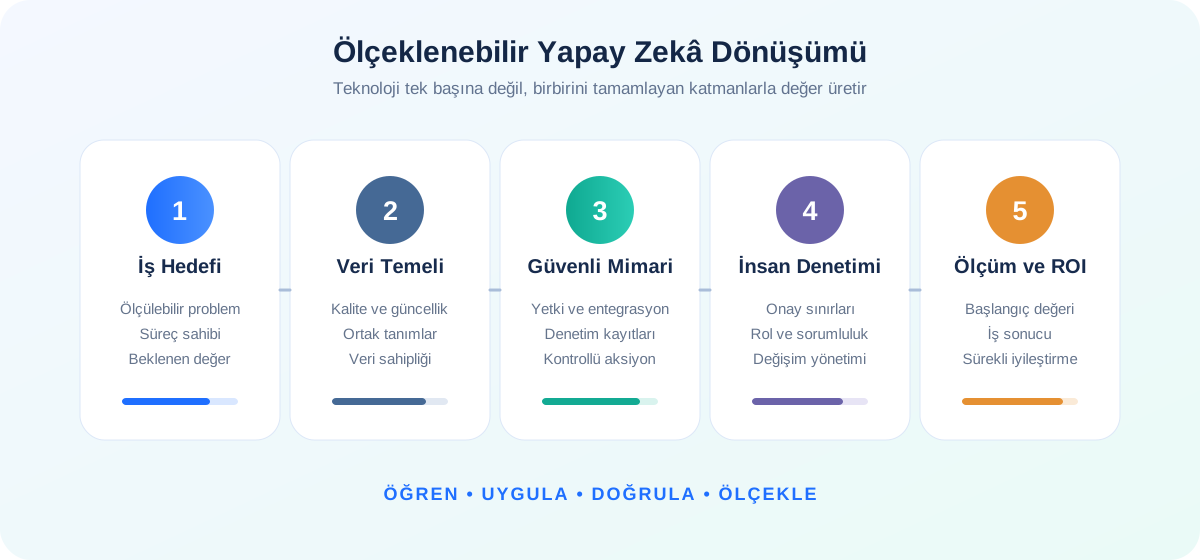
AI does not magically remove data problems; it often makes them more visible. Organizations should define ownership, quality, freshness, access, and retention rules for the critical dataset required by the selected use case. Existing ERP and BI investments provide an important foundation through common definitions and traceable process records.
Security must be designed from the beginning. The system should respect source-system permissions, record model outputs and tool calls, require human approval for high-impact actions, and provide stop, rollback, and escalation mechanisms.
A practical 90-day AI roadmap
- Days 1–15 — Discover processes, bottlenecks, data sources, risks, and baseline performance
- Days 16–30 — Select one pilot through a value-readiness assessment and define exclusions
- Days 31–45 — Design architecture, permissions, approvals, success metrics, and test scenarios
- Days 46–70 — Run the pilot with limited data and users in a real workflow
- Days 71–85 — Compare quality, time, cost, security, and user experience with the baseline
- Days 86–90 — Make the scale decision with ownership, budget, and an improvement plan
Measure business outcomes, not model quality alone
Technical quality matters, but management needs to know whether the solution changes an actual business result. Cycle time, backlog, manual error, rework, employee capacity, customer response time, adoption, intervention rates, total cost of ownership, and verified financial benefit should be monitored together.
Build the operating model around people and accountability
The most valuable model does not remove people from the process; it makes their time more valuable. AI can handle high-volume search, summarization, classification, and drafting, while employees manage exceptions, customer relationships, ethical judgment, and process improvement.
VGantt combines ERP, Business Intelligence, custom software, and AI capabilities in one transformation approach. We help organizations select the right use case, prepare trusted data, build secure integrations, and scale pilots through measurable business results.