
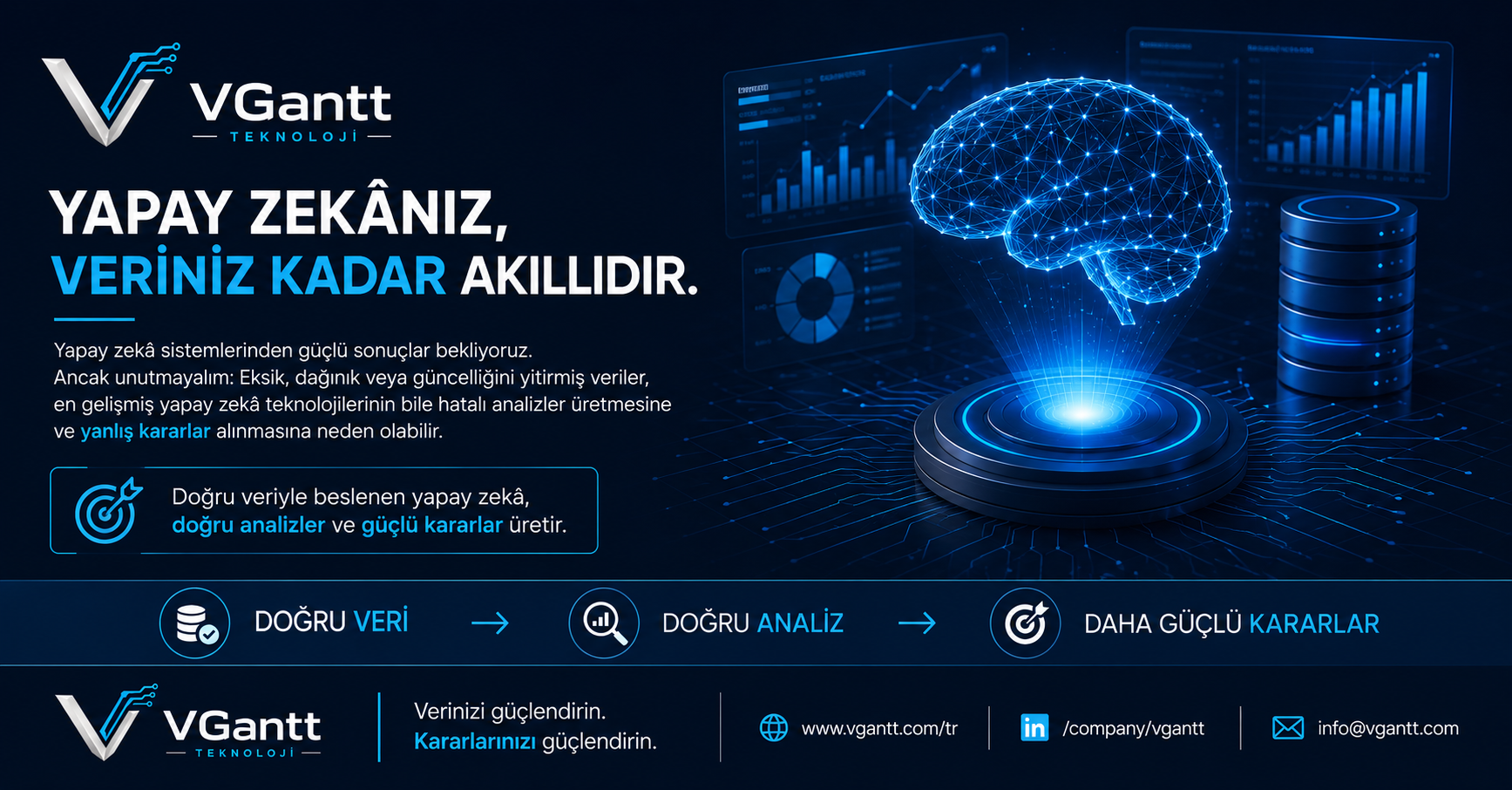
The hidden determinant of AI investment: data
Investment in generative AI, predictive systems, assistants, and AI agents is growing rapidly. Yet enterprise success is not determined by model size or platform choice alone. Accuracy, completeness, consistency, freshness, context, and traceability of the underlying data largely determine whether an AI system can produce trustworthy outcomes.
Incomplete, fragmented, outdated, or contradictory information can make even advanced models miss important signals and weaken decisions. AI does not magically repair existing data problems; it often reproduces them faster and at a larger scale. The key question is therefore not only whether a company uses AI, but whether its AI is powered by reliable data.
What does reliable data mean?
- Accuracy: Records reflect the real customer, product, inventory, order, or transaction state.
- Completeness: Critical fields and the context required for analysis are available.
- Consistency: The same entity and KPI have the same meaning across systems.
- Freshness: Information reflects operational reality at decision time.
- Uniqueness: Duplicate customer, product, and document records are resolved.
- Validity: Formats, values, and business rules follow defined standards.
- Traceability: The source and transformation history of data can be explained.
How poor data damages AI outcomes
Missing sales history weakens demand forecasts, outdated price lists create incorrect proposal drafts, duplicate customers distort lifetime value, and inconsistent maintenance descriptions reduce prediction quality. Poor data affects not only technical accuracy but adoption: after a few unreliable results, users lose confidence in the entire system.
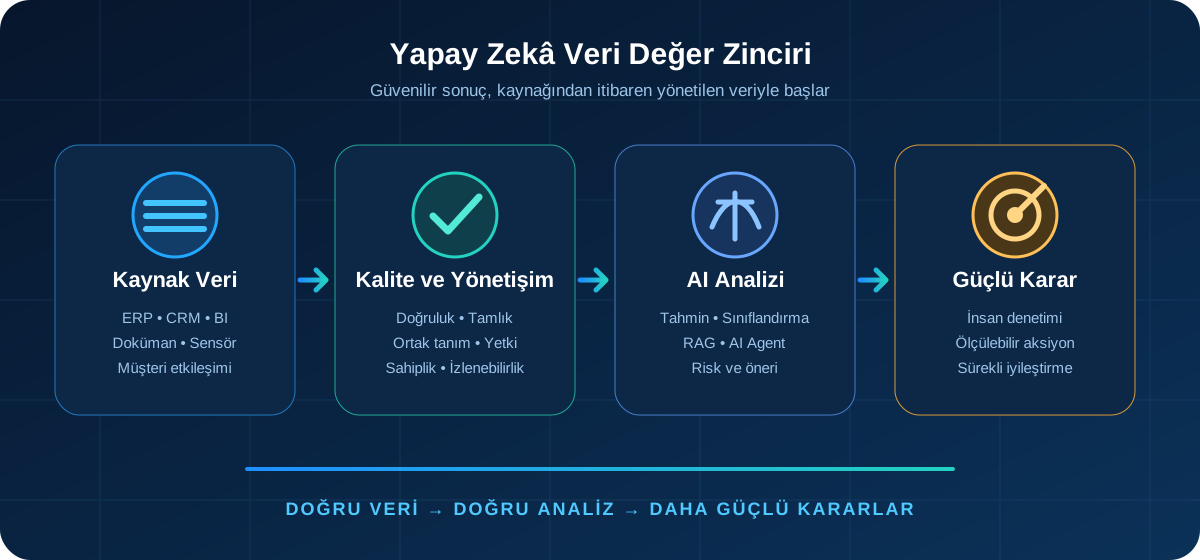
Trusted Data → Reliable Analysis → Stronger Decisions
Reliable AI is a continuous value chain. Source data passes through quality controls, receives shared business meaning, and becomes available under appropriate authorization. AI then produces analysis or recommendations, people validate high-impact outcomes, and measured business results feed continuous improvement.
ERP and Business Intelligence provide the operational foundation
ERP is the transaction memory of finance, sales, procurement, inventory, manufacturing, maintenance, and people operations. Business Intelligence turns these records into shared metrics and decision models. Standardized master data, common KPI definitions, and traceable process records give AI the context it needs to produce consistent answers.
Data quality is especially visible in RAG systems
Retrieval-augmented generation allows AI to answer from enterprise documents and databases. If those sources are outdated, duplicated, poorly tagged, or available without proper authorization, the resulting answers will also be unreliable. Ownership, validity dates, versions, metadata, access rules, and source citations must be managed as part of the product.
Data governance is a trust mechanism
Governance defines who owns data, how it is described, who may access it, how issues are corrected, and how changes are tracked. Business owners remain accountable for meaning and correctness; technology teams manage secure flows and infrastructure; AI product owners monitor model behavior, user experience, and business outcomes.
An eight-step data strategy for AI
- Define the business decision or measurable outcome the AI system should improve.
- Identify the critical dataset instead of attempting to clean every enterprise record at once.
- Build an inventory of sources, owners, update frequency, access method, and sensitivity.
- Measure accuracy, completeness, consistency, freshness, uniqueness, and validity.
- Create shared definitions through a business glossary, KPI catalogue, and master data standards.
- Design secure integration, authorization, masking, retention, and audit controls.
- Run a controlled pilot with limited data, users, and decision scope.
- Continuously monitor data drift, model quality, user feedback, and business results.
Measure data quality instead of assuming it
Every critical field needs a rule, target, and accountable owner. Useful measures include completion and accuracy rates, duplicate volume, cross-system inconsistencies, data latency, expired documents, source retrieval accuracy, and the percentage of AI outputs requiring human correction because of data problems.
Common mistakes
- Assuming a newer model will compensate for unreliable data
- Treating data cleansing as a one-time project
- Leaving business definitions entirely to technical teams
- Centralizing data without clear ownership and access boundaries
- Evaluating pilots without baseline data and business KPIs
- Monitoring model outputs without monitoring source-data changes
- Failing to provide a feedback route for incorrect or missing information
Strengthen your data, strengthen your decisions
Sustainable AI value begins with a trusted data foundation. Better data supports more reliable analysis, and reliable analysis helps people and automated systems make stronger decisions.
VGantt treats data not merely as an input to AI, but as a strategic asset that enables faster, more accurate, and sustainable decisions. We combine ERP, Business Intelligence, data integration, custom software, and AI capabilities to help organizations move from trusted data to measurable AI outcomes.