Competitive advantage comes from integration, not access
Using AI is no longer a competitive advantage by itself. Similar models, assistants, and automation products are widely available. The real difference is created by connecting AI to the right business problem, trusted data, and the right point in daily operations.
When reporting, analytics, task management, and automation remain isolated, technology provides fragmented support. Employees still move data between systems and manually continue the process after receiving an AI response. Real transformation begins when people, data, and AI become part of the same governed workflow.
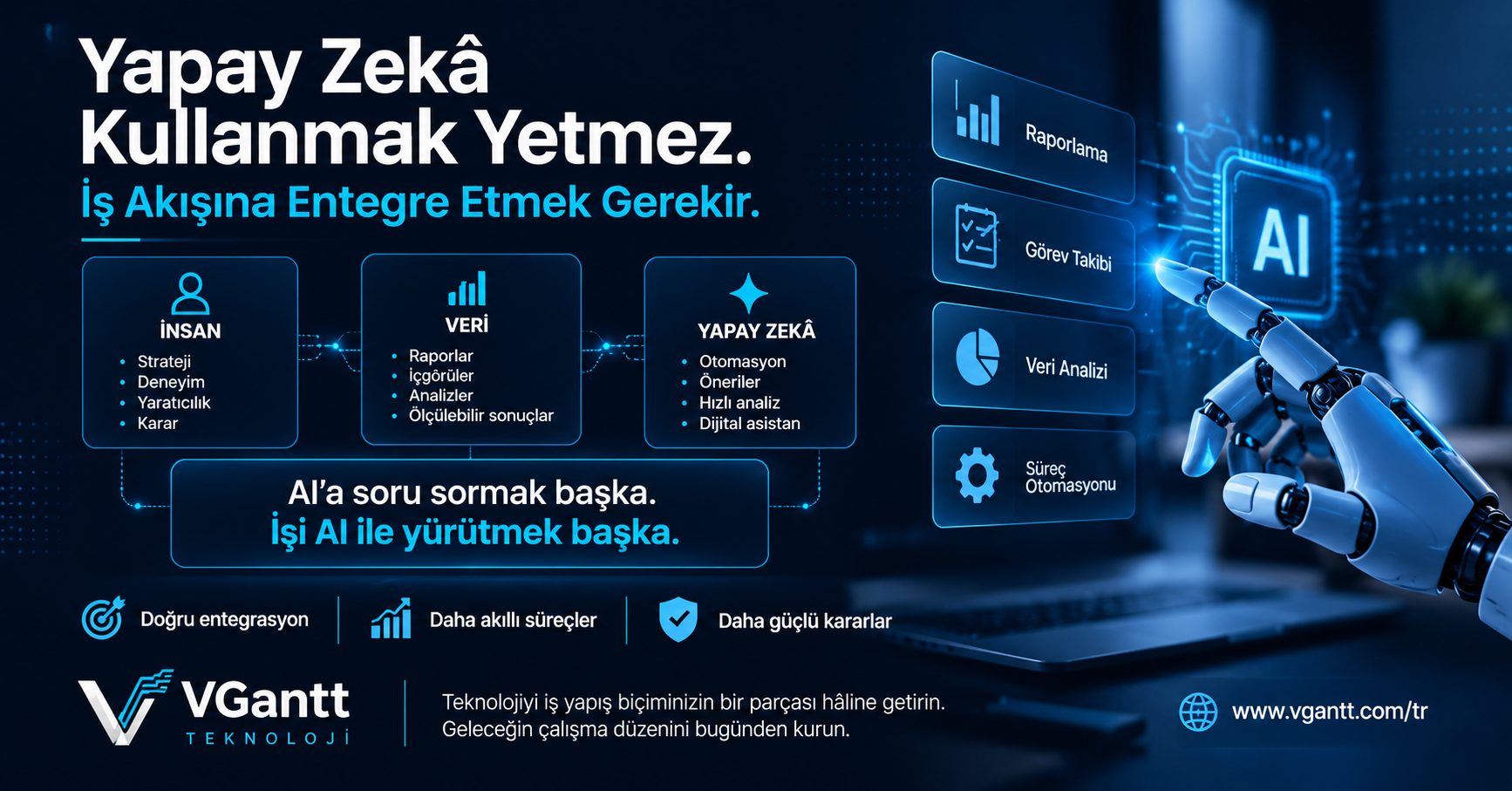
Asking AI a question is different from running work with AI
Uploading a sales report to a chat tool for a summary is useful but isolated. Running the process with AI means securely retrieving sales data from ERP or CRM, analyzing deviations on schedule, notifying owners, creating follow-up tasks, and measuring outcomes.
- A tool assists one task; integration targets an end-to-end business outcome.
- A prompt depends on a user; a workflow can start from a defined event or schedule.
- Copy and paste loses context and traceability; integration preserves source and history.
- A standalone response offers advice; a governed workflow turns insight into approval or action.
- General use creates personal productivity; process integration creates repeatable enterprise value.
People + data + AI: three parts of transformation
People provide strategy, experience, creativity, ethical judgment, and accountability. Data represents current operational reality. AI analyzes information at scale, reveals patterns, produces recommendations, and accelerates repetitive work. Weakness in any one component reduces the value of the entire system.
A practical enterprise integration architecture
- Source systems: ERP, CRM, manufacturing, finance, service desk, documents, and databases
- Data layer: validation, shared KPI definitions, freshness, deduplication, and authorization
- AI layer: classification, summarization, prediction, recommendations, assistants, or agents
- Business rules: thresholds, exceptions, permissions, and approval points
- Action layer: create tasks, send notifications, update records, or initiate approvals
- Observability: logs, cost, quality, cycle time, human intervention, and business KPIs
Where workflow-integrated AI creates value
- Management reporting that explains anomalies and prepares action-oriented summaries from ERP and BI data
- Sales workflows that enrich CRM records, summarize meetings, and create follow-up tasks
- Procurement workflows that read quotations, compare terms, flag missing information, and request approval
- Customer service that classifies requests, retrieves grounded answers, and monitors resolution
- Manufacturing and maintenance that interpret fault records and recommend controlled checklists
- Finance operations that review documents and route only exceptions to specialists
- People operations that coordinate onboarding, answer policy questions, and track learning needs
ERP and Business Intelligence are strong foundations
ERP contains the transactions of finance, sales, procurement, inventory, production, and maintenance. Business Intelligence turns those records into shared metrics. Together, they provide valuable context for AI that must support real operations rather than produce generic answers.
An AI system can move beyond summarizing a sales decline and relate it to inventory, pricing, shipment delays, and customer segments. This requires consistent definitions, secure APIs, and a common understanding of KPIs across teams.
Not every process should be fully automated
- Assistive: AI gathers information or drafts content while people retain all decisions.
- Approval-based: AI proposes an action plan and waits for authorization.
- Bounded automation: low-risk actions run within rules and exceptions go to a person.
- Autonomous workflow: considered only for narrow, mature processes with strong monitoring and rollback.
Security and governance are part of the integration
Once AI connects to enterprise systems, identity, role-based access, data masking, action limits, human approval, and audit trails must be designed from the beginning. The AI should receive least-privilege access, stop safely under uncertainty, and preserve a trace of every consequential action.
A six-step integration roadmap
- Define the cycle time, cost, quality, or customer outcome to improve.
- Map systems, data, manual steps, waiting points, exceptions, and owners.
- Prepare critical data and clarify ownership, freshness, and access rules.
- Define what AI drafts, recommends, or executes and where people approve.
- Run a controlled pilot with limited scope, users, and real data.
- Measure results and expand systems, users, and actions gradually.
Measure operational value and AI reliability
Compare cycle time, error rate, manual touches, task completion, adoption, satisfaction, and process cost before and after the pilot. Also track source retrieval, recommendation acceptance, human correction, failed integration calls, incorrect actions, and rollbacks.
Better integration, smarter processes, stronger decisions
Access to AI is becoming universal. Securely combining it with enterprise data, rules, and daily workflows is the capability that creates lasting advantage.
VGantt Technology combines ERP consulting, Business Intelligence, data integration, custom software, and process automation to make AI a natural and measurable part of how work gets done. Better integration creates smarter processes and stronger decisions.