
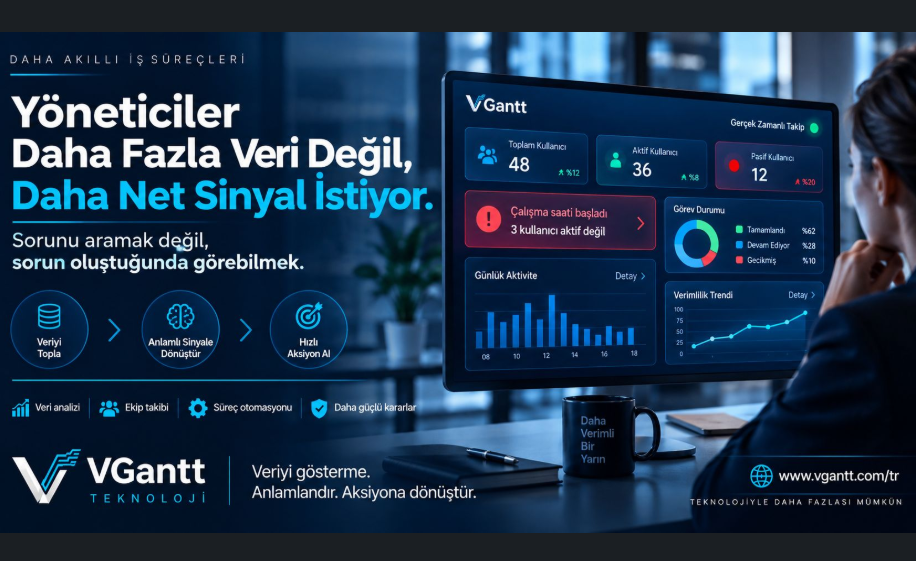
The management problem is not a lack of data
Organizations generate growing volumes of ERP transactions, sales records, production data, tasks, working-time events, customer requests, and financial metrics. Yet the central management question remains simple: what requires attention right now?
More data does not automatically produce better management. When critical information is buried in reports, dashboards, and disconnected notifications, it may be visible but not manageable. Value emerges when the right information reaches the right person at the right time with enough context to act.
Data, metrics, and signals are different
- Data is the raw record, such as a login time, task deadline, or order amount.
- A metric measures records according to a shared business definition.
- A signal explains that a meaningful change requires attention or action.
- An action assigns responsibility through a notification, task, approval, or review.
Not every change is a signal. A small sales decrease may be normal seasonality, while a sudden demand drop in a strategic product with sufficient inventory deserves investigation. Business context turns a threshold into a useful signal.
Why reporting alone is not enough
Traditional reports explain what happened, but often require a manager to open the right dashboard, select filters, and notice the deviation. Operations continue to change between reporting cycles. A modern management system keeps dashboards for the full picture while placing priority exceptions directly in front of the relevant decision maker.
What makes a management signal actionable?
- Event: What changed?
- Context: Which team, period, customer, project, or product is affected?
- Significance: How far is the change from a target, baseline, or expected pattern?
- Impact: What could it mean for cost, delivery, revenue, risk, or customer experience?
- Evidence: Which trusted sources support the signal?
- Recommendation: What should be reviewed or considered next?
- Ownership: Who should respond and within what time?
Examples across the enterprise
- Work management: missing expected activity, repeated delays in critical tasks, or unusual capacity changes
- Sales: lower conversion, reduced order frequency in a key account, or opportunities stalled at one stage
- Finance: overdue receivables, cash-flow variance, unusual spending, or approaching budget limits
- Inventory and procurement: critical stock levels, increasing lead times, or declining supplier performance
- Manufacturing: abnormal changes in scrap, downtime, throughput, or quality
- Customer service: longer resolution time, repeated complaint themes, or satisfaction risk in a valuable account
- Information security: unusual access, increased failed logins, or unexpected behavior around sensitive data
How AI improves signal quality
Fixed rules are effective for well-defined limits. AI can add value by learning normal patterns, connecting several metrics, and interpreting unstructured information. It can detect anomalies, reduce false alarms through context, classify recurring issues, summarize why a change matters, and route the signal according to role and impact.
AI recommendations are not final decisions. High-impact areas such as workforce evaluation, finance, customer commitments, and security require explainable outputs and authorized human judgment.
The goal is better prioritization, not more alerts
A poorly designed signal system creates notification fatigue. Separate informational, attention, and critical levels; consolidate repeated events; route alerts by role; and let users mark signals as useful, unnecessary, or incorrect. Success is measured by useful action, not alert volume.
Connect ERP, BI, and task management
ERP provides operational truth, Business Intelligence supplies shared KPIs, and task systems provide ownership and follow-up. In an integrated workflow, a signal links to supporting records, identifies the owner and response time, starts an approval when needed, and returns the outcome to the data layer for organizational learning.
Reliable signals require reliable data
Missing records, stale task states, duplicate customers, and inconsistent KPI definitions create false signals. Every KPI needs a clear definition, source, owner, update frequency, and quality threshold. Users also need a way to report incorrect data and inspect the evidence behind an alert.
A five-step roadmap
- Identify the critical decisions managers need to make earlier or more accurately.
- Define normal behavior, meaningful deviation, severity, impact, and ownership.
- Validate sources, freshness, access, quality, and shared KPI definitions.
- Connect each signal to a task, approval, investigation, or escalation.
- Measure true and false alerts, response time, resolution, and business outcome.
Turn data into action
Technology should do more than display what happened. It should explain why a change matters, identify what deserves attention, and help the right person act in time.
VGantt Technology combines ERP consulting, Business Intelligence, data integration, custom software, and AI to build visible, measurable, and action-oriented management systems. Collect the data, turn it into a meaningful signal, and act faster.